Showing posts with label Classic Kawasaki. Show all posts

9.30.2012

Detail Pembuatan Custom Mesin kz200 V TWIN

Kawasaki Binter Merzy bermesin V twin ini adalah kreasi Yusuf, sang owner bengkel Semangat Putra, Purwokerto. Tahun ini, kreasi mesin Binter Merzy yang aslinya satu silinder jadi 2 silinder v-twin! Kapasitasnya jadi 492 cc, karena satu silindernya 246 cc. Kalo digenapkan ya jadi 500 cc.

Tentu dengan membuat desain baru silinder tambahan. Posisinya agak tiduran, berada di bawah silinder asli yang tetap mempertahankan letaknya. Kira-kira 'V' sudutnya 60 derajat. Dengan posisi silinder asli yang tetap agak rebah, memang tidak terlalu V bentuknya. Bentuk L juga kurang. Tapi intinya, silinder bebentuk V.
Untuk mendesain mesin jadi dua silinder, Yusuf harus mengatur ulang pen kruk-as dan big-end tambahan. Agar supaya silinder kedua juga bisa ikut gerak mengikuti putaran kruk-as. Agak rumit memang. Kalau hanya mengubah dan membobos crancase asli dipastikan iya. "Soalnya harus membuat lubang baru untuk masuknya boring di crankcase," papar brother dari Jl. Sultan Agung, No. 8, Karang Klesem, Purwokerto.

Agar dua setang seher bisa terpasang, secara mekanismenya, Yusuf menipiskan pada bagian big end-nya. Juga menipiskan bandul kruk as. karena ukuran mesin tidak dilebarkan. Makanya semua komponen di dalamya kena pangkas.

Agar connecting rod baru bisa terpasang, pada setiap sisi kiri dipapas 4 mm untuk setiap setang. Sedang daun kruk-asnya 4 mm totalnya, juga per daun 2 mm. Total papasan jadi 16 mm. Termasuk bikin jalur oli silinder baru. Mekanismenya tetap seperti standar. "Hanya dikasih swith kontrol oli. Tujuannya agar kerja krus-as tetap optimal," terangnya.

Pemasangan blok tentu saja memerlukan pembubutan. Karena harus membuat lubang agar bisa jadi dudukan blok baru. Yusuf tinggal bawa ke bengkel bubut Prijaya. "Saya pastikan agar pembubutan presisi dan enggak geser meski cuma 1 micro," terang kelahiran 18 Juli 1979 ini.

Untuk menambah kapasitas yang aslinya 200 cc, setiap silinder dibore up. Yusuf manfaatkan piston dari mobil Honda Excelent, yang sudah oversize 50. "Diameter 72,5 mm. Lumayan kapasitas jadi gemuk. Nyaris jadi 500 cc," tambah Yusup lagi.

Untuk urusan pengapian, Yusuf berpendapat sudut pengapian harus beda 60 derajat antar silindernya. Sebab silindernya juga memiliki sudut 60 derajat. Makanya antar pulser harus 60 derajat juga. Namun hal itu tidak bisa dilakukan. "Sebab jarak pick up pulser di magnet tidak bisa digeser sejauh itu. Makanya dibikin 35 derajat dan tonjolan dua dalam satu magnet," ujar Yusuf.

Jadi walaupun masih pakai satu magnet, namun masing-masing silindernya punya pengapian. Sedang untuk sudut pengapianya Yusuf menggeser di posisi top maju sejauh 16 derajat sebelum TMA (Titik Mati Atas) agar letikan api bisa maksimal. "Dibantu aplikasi koil RX-King yang punya dimensi besar. Semburan api juga stabil dan kencang," tambah pria berkulit agak gelap ini.


Efek dari kerja mesin yang cc-nya sudah ditambah itu, tentu saja pada power. Yusuf merasakan betul motor jadi makin galak. "Saya memakai sproket 15/30. Itupun masih terlalu liar. Gigi tiga masih suka wheelie kalau digas menghentak," bangganya.

Menurut pria kalem ini, akan lebih nyaman jika set gir dihitung ulang. Meskipun tetap pertahankan rasio aslinya. "Lebih pas mungkin kalau 15/25. Sayangnya, kan gak ada gir bermata 25 dengan ukuran 520. Jadi, sementara ini dibiarkan aja pake 15-30," curhat ayah Nada Fitria Ramadhani ini.

Kelar urusan mesin, Yusuf coba bangun konsep modifikasi tampilan motor. wong Purwokerta ini mencoba hadirkan selera baru. Dia memilih konsep yang mirip dengan Jap's style. "Namanya Brat style. Memang mirip sama Jap's style," ucapnya.

Konsep ini terlihat pada sudut rake sokbreker depan yang cenderung lebih tegak. Kalau diperhatikan mirip rake motor speedway. Sementara, desain bodi lebih mengarah pada konsep ke bobber. Dengan komposisi seperti ini, handling motor memang cenderung lebih enak. Tapi kalau jarak jauh memang lebih nyaman motor yang rakenya lebih renggang.

"Karena konsepnya fungsional. Tentu saya tidak melupakan pernik pendukung keamanan. Misal, spion," ucap Yusuf yang mau turing ke Bojonegoro sekaligus merayakan ultah.

DATA MODIFIKASI

Sok depan : Segitiga GSX 400
Sok belakang : Yamaha RX Z
Sasis : Handmade
Tangki : Handmade
Jok : Handmade

sumber : m-plus


Nothing in this website or have trouble finding what you are looking for? Please use our special search from Google
Share

9.26.2012

Kz200 V Twin Custom


 Memang rada aneh ya kalau binter merzy a.k.a kz200 di buat V twin tapi itulah hasil karya anak bangsa yang telah berhasil mewujudkan mimpi Binter merzy V Twin, Ya betul Semangat Putra Motor telah berhasil mewujudkan Custom mesin yang begitu mengejutkan.

SEMANGAT PUTRA MOTOR yang berada di Purwokerto tepatnya beralamat di  
Karang Klesem rt 3 rw 10 
purwokerto selatan, 
Banyumas, 
Jawa Tengah, Indonesia 53144

 Telah berhasil merubah mesin binter merzy yang berkapasitas 200 cc menjadi 2 kali kapasitas standar dari motor klasik kita tercinta kz200, Informasi yang saya dapatkan mengkustom mesin seperti ini biaya yang harus dikeluarkan tidak lebih dari 18 Juta perak saja

Kalau brother ada yang minat meng custom motor kz200 v twin bisa kontak ke brother Yusuf Semangat putra motor di nomor mobile phone 0857-4706-4611 supaya lebih detail dan jelas semuanya..

Berikut foto kz200 yang telah dipasang mesin kz200 V Twin


Keren Banget Kan ???? Mantap Blar...blaar...blaaarrr !!!!!
  
 Nothing in this website or have trouble finding what you are looking for? Please use our special search from Google
Share

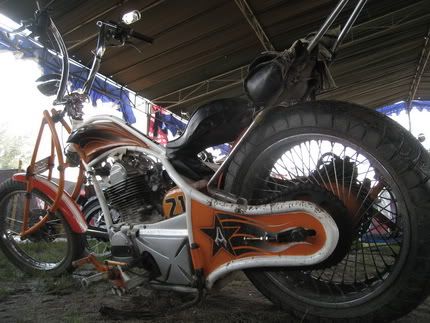
Alalsan kz200 a.k.a Binter Merzy mudah dibuat Chopper

Belakangan ini, tren sepeda motor yang dibentuk menyerupai Harley Davidson atau chopper sedang digandrungi kalangan bikers. Tak peduli duit bakal keluar, demi menyerupai motor asal Amerika yang melegenda itu. Tapi, dari berbagai sepeda motor yang bisa diubah bentuknya dengan mudah menyerupai Harley adalah Kawasaki Binter Merzy (KZ 200).


Memang, untuk diubah menjadi chopper, sepeda motor apapun bisa. Terlebih, jika ditangani oleh mekanik yang ahli. Namun, dari semua sepeda motor itu yang paling mudah dibentuk chopper adalah  Kawasaki Binter Merzy (KZ 200). Mengapa mudah? Karena Kawasaki Binter Merzy (KZ 200) bentuk rangkanya cukup besar sehingga mudah dibentuk menjadi mirip Harley Davidson.

Di Indonesia, Binter adalah merek lokal dari sepeda motor Kawasaki. Nama 'Binter' sendiri adalah singkatan dari 'Bintang Terang', yaitu nama perusahaan distributor sepeda motor ini. Merk ini terakhir digunakan pada tahun 1983 ketika Kawasaki di Indonesia menutup usahanya.

Kawasaki di kemudian hari membuka kembali usahanya di Indonesia, tetapi tidak lagi menggunakan merk 'Binter'. Binter Merzy/KZ 200 adalah sepeda motor kelas menengah dengan mesin 200 cc silinder tunggal. Motor ini adalah sepeda motor produksi massal resmi terbesar kapasitas mesinnya di Indonesia, sampai pada saat Suzuki Thunder 250 cc diluncurkan di Indonesia.

Pada tahun 1983, sepeda motor ini mengadopsi sistem CDI sampai produksinya dihentikan pada tahun 1984. Awal produksi spesifikasi ini disebut Merzy CDI. Pada tahun 1984, selama masa produksi terdapat 1 kali perubahan model di tahun akhir dari model pendahulunya, menjadi lebih sporty atau yang biasa disebut Merzy New Tank atau Merzy Cobra.

Pada waktu tersebut, Kawasaki Motor pernah direncanakan akan meluncurkan model baru dengan peningkatan kapasitas mesin 250 cc. Namun, peraturan pemerintah di Indonesia pada waktu itu menolak kapasitas mesinnya. Peraturan di Indonesia pada waktu itu membatasi kapasitas maksimum mesin motor 200 cc, untuk konsumsi publik.

Itulah sekilas tentang Binter Merzy/KZ 200, merk sepeda motor di Indonesia yang hampir 'terlupakan' oleh khalayak umum. Namun, di tangan para penggemar fanatiknya, motor ini masih banyak dalam kondisi yang terawat baik. Walaupun mereka dihadapkan pada persoalan minimnya suku cadang, sehingga mereka mengakalinya dengan cara meng-kanibal spare part dari motor merk lain ataupun bahkan suku cadang mobil.


Nothing in this website or have trouble finding what you are looking for? Please use our special search from Google
Share

4.22.2011

KAWASAKI KZ200 In Europe Distribution

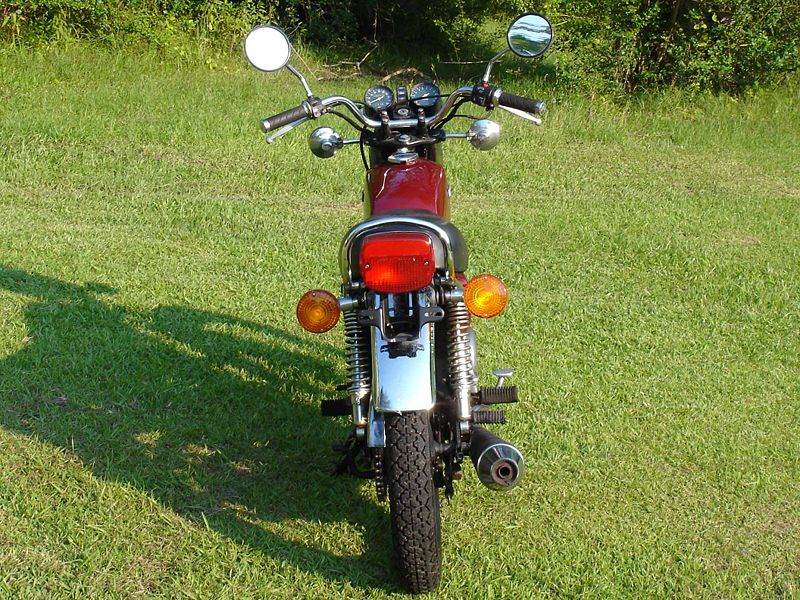
Kawasaki KZ200 A1 1977-1978

Kawasaki+KZ200+A1+2 Kawasaki KZ200 A1 1977 1978
Kawasaki KZ200 A1 1977-1978
Specifications :
Manufacturer : Kawasaki
Production : 1977-1985
Class : Street bike
Engine : 200cc, four-stroke, single cylinder, Single Over Head Camshaft,5-Speed Return Shift.
Sparkplug : NGK B7ES

Front Tire : 2.75-18 4PR
Rear Tire : 3.25-17 4PR
Fuel Tank color: Cerulean Blue, Garnet Brown.
Remarks: Four-stroke, single-cylinder commuter, with mechanical front disc brake, safety side stand, and electric starter. Steering lock is combined with ignition switch.
Source and Photo Credit : www.cyclechaos.com
Kawasaki+KZ200+A1+1 Kawasaki KZ200 A1 1977 1978
Kawasaki KZ200 A1 1977-1978
Kawasaki+KZ200+A1+3 Kawasaki KZ200 A1 1977 1978
Kawasaki KZ200 A1 1977-1978
Kawasaki+KZ200+A1+4 Kawasaki KZ200 A1 1977 1978
Kawasaki KZ200 A1 1977-1978
Kawasaki+KZ200+A1+5 Kawasaki KZ200 A1 1977 1978
Kawasaki KZ200 A1 1977-1978

Share

4.21.2011

Binter Merzy Brothers - Another Classic Motorcycle of Kawasaki

Voyager
 
This motorcycle is a Cruiser type from Kawasaki. With big engine capacity about 1300cc.


Eliminator

The Kawasaki Eliminator is a cruiser-type motorcycle that has been produced in several variants since its introduction in 1985 as the ZL900. Currently billed as a "power cruiser", the first two incarnations of the bike, namely the 1985 and 1986 ZL900 models, were in fact almost street replicas of a drag style bike, featuring shaft drive, very short gearing and forward seating with a handlebar that barely qualified as legal. The motor for both of these machines was in fact the same motor available in the 900cc Ninja of the same year, albeit with slightly different exhaust and intake configurations. These were, and remain, two of the highest performing straight line un-cowled motorcycles to be sold to the public.


Kawasaki KZ1300

This bike has six cylinder with 1300cc capacity.


Kawasaki Z900/Z1

The Z1 Kawasaki was a motorcycle introduced in 1972 by Kawasaki Heavy Industries. It has been described as the world's first superbike, but that term is probably better applied to Honda's CB750, which introduced the four-cylinder, across the frame, disc-braked layout.


Kawasaki KZ750 (Twin)

Produced for model year 1983, the Kawasaki KZ750 L3 was very similar to the 1982 Gpz750. This is the year during which the Gpzs made the jump towards "sportbikes", while the KZ line branched off as "sport cruisers". This model can be distinguished by the three horizontal stripes along the gas tank and tailpiece, orange, red and yellow, and the lack of fairing typical on GPZ bikes of the same era. The Kawasaki inline-four engines are considered very robust and reliable. Therefore, this motorcycle, and others with similar engines, are sought after for their rideability and repairability.


Source : http://merzy-rider.blogspot.com

Share

10.18.2008

THE KAWASAKI W650


The Kawasaki W650 is a different kind of retro bike, a standard easy to mistake at first glance for a late 1960's Triumph Bonneville. Kawasaki claims that the W650 was inspired by their own W1 twin of 1967 (itself a knockoff of the BSA A10, a pre-unit construction 650), but anyone who has seen a W1 knows the W650 looks nothing like that, and very much like the vastly more popular Bonneville.

The gas tank shape, tank badges, rubber kneepads, rubber fork gaiters, cases, mufflers, seat, fenders, headlight, and paint job are all clearly influenced by late 1960's Triumph design. This is not bad thing, as the T120 Triumph Bonneville 650's are widely regarded as some of the most beautiful motorcycles ever built. The W650 styling is a success, as it garnered positive comments from observers everywhere that it went.

It is hard not to compare the W650 to the vintage British motorcycles it resembles, as well as the contemporary Harley-Davidson 883 Sportster and new Triumph Bonneville 800, which are its natural rivals. (See my article 2001 Comparison: Bonneville, Sportster, W-650.)

My 2000 model test bike's gas tank came with two tone "Galaxy Silver" and "Luminous Blue" paint, set off by gold pin striping. The quality of the paint job was very good. The frame, front forks, side covers, chain guard, rear hub, and rear shock covers were all painted black. The seat is black vinyl with white piping. The engine/transmission cases, various smaller engine bits, and wheel rims are polished alloy. The pipes and mufflers, fenders, headlight, turn signals, and sundry small pieces are chromed. The overall look is very appealing.

Like a classic Triumph 650, an air-cooled vertical twin in which both pistons rise and fall together powers the W650. However, this Kawasaki twin is counterbalanced to control vibration, has a single overhead cam driven by a hypoid gear with an offset bevel drive shaft, four valves per cylinder, and displaces 676cc. Bore and stroke is 72x83mm. Twin Keihin 34mm CV carburetors deliver the fuel/air mixture to the engine, and the ignition is electronic. The slick shifting five-speed transmission has positive stops at first and fifth gears. Fifth feels like an overdrive gear, and keeps the RPM down when cruising on the interstate. Final drive is by chain. According to a Cycle World magazine test, this engine produces 44.7 hp at 7,050 rpm and 37.5 ft. lbs. of torque at 5,100 rpm at the rear wheel.

Performance figures from the same Cycle World test revealed a 1/4 mile time of 14.33 seconds at 92.54 mpm, and a 0-60 time of 5.6 seconds. The bike's top speed was 101 mph, and it averaged 41 miles per gallon of fuel.

The W 650's double cradle frame has a square backbone, unlike the classic T120 Bonneville that had a single downtube frame built of round tubing. The engine is rubber mounted in this frame to keep vibration away from the rider. The steel swingarm is conventional in design.

The suspension components seem to have been chosen more on the basis of price than performance. The same could not be said about the T120 Bonneville in its heyday. Of course, suspension standards are much higher now. Front fork rake is 27 degrees, and trail is 4.1 inches. The 39mm telescopic forks have 5.1 inches of travel. The front forks of the W650 offer no adjustment, and dive excessively under hard braking. Progressive front fork springs would probably cure this. The twin rear shocks are adjustable for spring preload only, and have 4.1 inches of travel.

The attractive laced wheels feature neat lightweight alloy rims. The stock tires are Bridgestones, apparently designed to resemble classic Dunlop K-70's. The front is a ribbed 100/90x19, and the rear is a 130/80x18. I didn't have any trouble with them but if I owned this bike, when tire replacement time rolled around, I would shop for higher performance rubber, available from from Dunlop or Metzler.

The hydraulic front brake is a single 300mm disc with a twin piston caliper; the rear wheel has to make do with a mechanical drum brake. This combination provides predictable stopping power, but a second front disc would be a worthwhile improvement.

Standard instruments include both a speedometer and tachometer, mounted in front of the handlebars where they are easily seen. The LCD odometer is built into the face of the speedometer, and also offers trip meter and clock functions. I found the clock to be a particularly useful feature. The tach houses an array of idiot lights for neutral, high beam, oil pressure, and turn signals. The fork lock is conveniently combined with the ignition switch, which is located at the top of the triple clamp.

The four gallon gas tank has comfortable kneepads and a flat, locking, gas cap. From the side it looks like a classic Triumph gas tank, but from the riding position it is much wider. One of the most attractive features of the classic Bonneville 650 was its svelte 2.5 gallon tank, a fact that seems to have been overlooked by Kawasaki. An unsightly pressed steel seam runs completely around the lower edge of the tank. Nevertheless, overall it is a good looking gas tank

The ersatz Triumph-like chrome tank badges are fastened with an adhesive, and can be removed without damaging the paint job, as can all the other Kawasaki badges and decals on the bike. Since I feel that the tank badges detract from the lines of the tank, I would remove them if this were my personal bike. In the past I have found that a hair dryer works well for this.

I would also remove the word "Kawasaki" from the back of the dual seat (contact cleaner or something similar will work here). On the other hand, I thought the gold "W650" decals on the black side covers (which form the air box for the twin carbs) restrained and appropriate, and I would leave them in place. My purpose would not be to conceal the fact that this bike is a W650, but rather to clean up details I regard as unsightly. The cheap looking front and rear side reflectors are equally easy to remove, and their absence would also help to clean up the appearance of the bike.

A W650 weighs 434 pounds dry, quite a bit more than a T120 Bonneville's 386 pounds. Wet weight is about 460 pounds. Wheelbase is 57.1 inches, and ground clearance is 4.9 inches. The W650's seat height is 31.5 inches, but the bike is narrow, which helps the rider's feet reach the ground.

Nice features include the attractive chrome fenders, the flexible turn signal stalks (designed to reduce the chance of damage in a tip over), chrome passenger grab handles, a center stand (in addition to a kick stand), kick as well as electric starting, and the big chrome headlight.

Not so nice features include the lack of self-canceling turn signals, the ugly black painted rear hub, the dim dash lights that are hard to see in bright sunlight (a common complaint with many motorcycles), the ineffective horn, and the ungainly combined tail light, rear turn signal, and license plate bracket. Perhaps the aftermarket could supply something to replace the latter.

Kawasaki offers very little in the way of accessories for the W650 as of this writing. I hope they take steps to improve the situation, but for now adapting "multi-fit" parts from aftermarket suppliers is about the only recourse. There is a Yahoo W650 Registry on the web to assist W650 fans find accessories and information. The URL is: http://groups.yahoo.com/group/W650Registry

Riding the W-650 revealed no surprises. It started immediately when I pressed the starter button. I have kick started all the real Britbikes I ever want to, so I eschewed the kickstarter, but the dealer (Cycle Sport of Eugene, OR) assured me that it will start with one kick.


Despite its British appearance, this Kawasaki feels like a typical Japanese motorcycle. The engine is smooth and the transmission shifts easily and precisely, a definite improvement over vintage British bikes. The exhaust note is very restrained; I would drill out the baffles or invest in a set of freer flowing mufflers if I owned a W650. The brakes are adequate for the bike's performance. The mirrors are functional at speed and offer a decent rear view. They are a pleasant departure from the inferior mirrors on vintage British bikes.

Another departure is the excellent halogen headlight, which offers a low beam suitable for riding in town and a high beam bright enough for lonely country roads at night. The lighting on classic British bikes was atrocious.

The seating position is basically pretty upright, although the flat seat lets the rider move around to change position, and makes it easy to lay on the tank for brief high speed runs. There is a slight rise and a hard spot in the middle of the seat exactly where I wanted to plant my butt. (I am 5' 10" tall, with fairly long arms.) I understand that Kawasaki has improved the seat on 2001 models. The wide handlebar has a standard bend and conventional Japanese switches and controls. I didn't ride the W650 with a passenger, but I judge that one could, at least for short jaunts. Longer trips would probably find the seat too cramped for comfort.

Engine performance is good, if not overwhelming. The red line is at 7500, although the tach reads to 9000 RPM. Torque seemed best, and the engine seemed happiest, in the middle of the RPM range. My test bike was not completely broken-in, so I did not wind the engine all the way out. In any case, the motor's power characteristics are such that I felt no need to do so. It is definitely more fun to twist the right grip of a T120 Bonneville.

The W650 revealed no handling vices, unlike many older Japanese twins. However, it did not give me the confidence a 1969 Bonneville used to inspire. It will probably go through corners about as fast, but somehow it didn't feel as eager to me. Other reviewers have expressed similar opinions about the 2000 model W650, so for 2001 Kawasaki subtly adjusted the rake and trail of the front end for improved feel.

One of the nice things about classic style standard motorcycles is that small changes to incorporate minor improvements are all that is required to keep the bike current. We can anticipate the W650 remaining essentially the same for many years. Change for the sake of change, with its negative impact on resale value, is unlikely.

I see the W650 as an excellent city and commuter bike that is also more than adequate for Sunday rides out of town or the occasional weekend trip. It looks great and offers good overall performance. Like other standard motorcycles, it can serve multiple purposes. It feels more refined than vintage British 650's, but lacks the mechanical presence and "fun factor" of these machines. It also lacks the vibration that plagues a vintage Britbike.

The W650 offers neat styling and modern reliability, without oil leaks. It is likely to hold its value well. I regard it as one of the best all-around medium displacement motorcycles on the market today. It is not a particularly cheap motorcycle, nor does it have a lot of trick features. But it is smooth and enjoyable to ride. It is hard to imagine anyone not liking it.

1972 Kawasaki H2 750 Mach IV

The 1972 Kawasaki H2 750 Mach IV motorcycle was one of the quickest bikes of the early 1970s, but also one of the most difficult to master.


The landmark Kawasaki H2 750 IV was known not
only for its speed, but for its tricky handling
and poor fuel economy.

Founded in the late 1800s, Kawasaki has been into everything from planes to trains to shipping. It began supplying small motorcycle engines, complete with transmissions, to other manufacturers just after World War II, and began offering its own bikes in 1960.

This new segment of the company advanced -- and grew -- quickly. One of the manufacturers using those small engines was Meguro, which Kawasaki bought out in the early 1960s.

The first motorcycles to wear Kawasaki badges were 125-cc commuter bikes. These didn't sell well when the company exported them to the United States.

But Meguro had also been building a 650-cc four-stroke overhead-valve twin under license from BSA (the English company's old pre-unit model). This rather tame motorcycle met with a fair degree of success in the U.S. when introduced as the Kawasaki W1 in 1966.

But better -- and faster -- models were yet to come. First up was a 250-cc two-stroke twin called the Samurai. The Kawasaki Samurai was certainly an about-face in philosophy from the W1.

Fitted with rotary disc valves, it was a hot little number, and the temperature was raised further by the 350-cc Avenger that followed.

And then came the big one.


In the midst of numerous new "superbikes" being introduced by Triumph, BSA, and Honda, the Kawasaki 500-cc H1 Mach III two-stroke triple stood out as a ferocious performer at a cut-rate price.

Light and very powerful, with 60 horses that seemed to lie in wait and then suddenly stampede when the revs built up, rumors spread of Mach IIIs rearing up to throw their riders off on the first test drives. But in the raging superbike wars, "too much" was still not enough.

Enter the 750-cc 1972 Kawasaki H2 750 Mach IV motorcycle. With 74 horsepower on tap, it was even more fearsome than the Mach III. And not surprisingly, it inherited several of its predecessor's flaws, namely squirrely handling, a propensity to wheelie, and horrific fuel mileage.

So although it was perhaps the ultimate performance two-stroke of the day, the market -- and Kawasaki -- would soon drift toward more civilized four-strokes.

Go to the next page for more great pictures of the 1972 Kawasaki H2 750 Mach IV motorcycle.


Meguro the king of four strokes


As you read every word of this article, you will discover why Kawasaki Motorcycles were considered the Mavericks of the industry...

The story of Kawasaki Company goes back to 1924, at that time involved into metallurgy and the aircraft industry.

In 1949, they decided to enter the motorcycle industry producing engines that could be adapted to motorcycles.

FIRST KAWASAKI MOTORCYCLE INDUSTRY RELATED PRODUCTS

Motorcycle Engines

In their line you could find a 60 cc two-stroke, as well as a 150cc and a 250cc four-stroke engines developed with technology from BMW; company whom with they had had relationships since their beginnings in the aeronautical industry.

It wasn't until 1954 that Kawasaki Motorcycles produced their first complete motorcycle under the name of Meihatsu (a subsidiary of Kawasaki Aircraft Co.).

Almost at the same time, they also tried to introduce their own line of scooters to the market, but they soon realized they couldn't compete against the two giants of the scooters industry for those days: the Fuji Rabbit and the Mitsubishi Silver Pigeon.

And now before continuing with this story, I have to open a big parenthesis..

IMPORTANT INFORMATION ABOUT THE HISTORY OF KAWASAKI MOTORCYCLES


We cannot talk about Kawasaki without mentioning another make that will definitely help Kawasaki become as well as Honda, Suzuki, and Yamaha one of the big players in the Japanese Motorcycles scene:

--> Meguro Motorcycles: better know in that time as the "senior make and the king of four strokes".

Meguro entered the motorcycle industry in 1937. Having a good relationship with the government, the people at Meguro took advantage of the army orders.

Their first motorcycle was the Z97: a 500cc rocker-valve motorcycle influenced by the Swiss Motosacoche. It's worth mentioning this model was a success for the factory and the Z97 was in production till the fifties.

Along the years, Meguro produced some very nice 250cc and 350cc rocker-valve, single cylinder models as well as high performance twins. All of them with a very strong British influence. Then and thanks to the commercial success they were living, they also launched a rocker-valve 125 cc for their low end range and a twin cylinder 650cc to accompany the already existing 500cc.

But it was in 1958, when Meguro tried to get rid of their British influence, when things started to go wrong...

Based on a winning prototype of Mount Asama (one of the biggest races that time), Meguro Motorcycles produced three nice and elegant machines with overhead camshaft: the 125cc E3, the 250cc F and the 350cc Y A. Unfortunately these bikes turned out to be too heavy and didn't get the buyers' attention. Meguro will soon return to rocker valve models.

Meguro Motorcycles remained as one of the top 10 manufacturers till 1960, but due to some bad decisions, as the ones mentioned above, the company started to decline and was soon bought by Kawasaki.

In 1960 Meguro signed an initial agreement with Kawasaki Motorcycles, and in 1962 they had completely disappeared.

And this brings us back to our story...

In 1960, the company decides to give a serious push to the motorcycle division of Kawasaki Aircrafts. They take out of the market the Meihatsu brand, they build their own plant of low end and low powered machines and buy Meguro.

These brilliant moves and decisions made Kawasaki Motorcycles have one of the widest range of models in the market. Kawasaki Motorcycles could offer at that time (1960's) from a 50cc moped-scooter to a powerful, high end and beautiful 650 cc twin cylinder motorcycle.

Its also important to mention that due to their very own nature, Kawasaki Motorcycles has always played the role of Maverick in the industry and that a feeling of independence from their main competitors has always been present.

Since then, many stories have been written, many models have been produced and many races have been won, the truth is...

Nowadays Kawasaki Motorcycles is one of the major players in the industry and following their tradition, they nowadays offer a wide range of products for all kind needs and likes.

You can also take a look at Kawasaki 2006 line-up . Check this page (The link will open in a new window. Don't forget to come back to keep learning about Japanese Motorcycles:-):

Kawasaki Motorcycles line-up.

Popular Posts


Other Modification of kz200 Binter Merzy

MERZYMANIA Headline Animator


Page Ranking Tool
BlogFlux Tools
Blog Directory & Search engine
Blog Directory


Msn bot last visit powered by MyPagerank.Net